Managing a globally distributed workforce used to mean managing chaos. A spreadsheet here, an email chain there, a compliance question no one could answer confidently until the tax authority asked first. For HR leaders and global mobility teams navigating cross-border remote work in 2025 and beyond, that approach is no longer acceptable or defensible.
Horizon by Topia is built to change that. Its Remote Work module transforms a historically fragmented, reactive process into a structured, automated, and fully auditable workflow from the moment an employee submits a cross-border work request to the moment it's approved, denied, or escalated for compliance review. This post covers everything you need to know about how Horizon handles remote work: what risks it addresses, how the approval workflow operates, what the risk assessment engine evaluates, and why this matters for organizations with employees working across international borders.
The Problem: Cross-Border Remote Work Is a Compliance Minefield
The rise of distributed and hybrid work has created a new class of compliance exposure that most organizations were not built to manage. When an employee works remotely from another country, even temporarily, a cascade of legal and tax obligations can be triggered that the employer may not discover until long after the fact.
The four primary risk domains are:
- Tax withholding obligations. An employee working from a foreign jurisdiction may create a payroll tax obligation in that country, even if they are employed by a company headquartered elsewhere. Getting this wrong means penalties, back taxes, and potential reputational damage.
- Immigration status. A work visa issued for one country does not permit employment activity in another. An employee working remotely from a country where they are not authorized to work is violating immigration rules, and so is the employer who knowingly allows it.
- Social security contributions. Cross-border work can disrupt bilateral social security agreements (totalization agreements), potentially triggering dual contributions or gaps in coverage.
- Permanent establishment (PE) risk. This is the exposure that keeps tax directors up at night. If an employee in a foreign country is deemed to be habitually concluding contracts on behalf of the company, that country's tax authority may assert that a taxable presence, a permanent establishment, exists there. The financial and operational consequences can be severe.
Most organizations today manage these risks reactively, if at all. Horizon was designed to flip that equation.
What Horizon's Remote Work Module Does
Horizon's Remote Work module is a purpose-built system for managing cross-border remote work requests through a structured, intelligent workflow. It combines an interactive visualization layer, a multi-step approval engine, and an automated risk assessment framework into a single platform.
An Interactive World Map That Shows You Everything
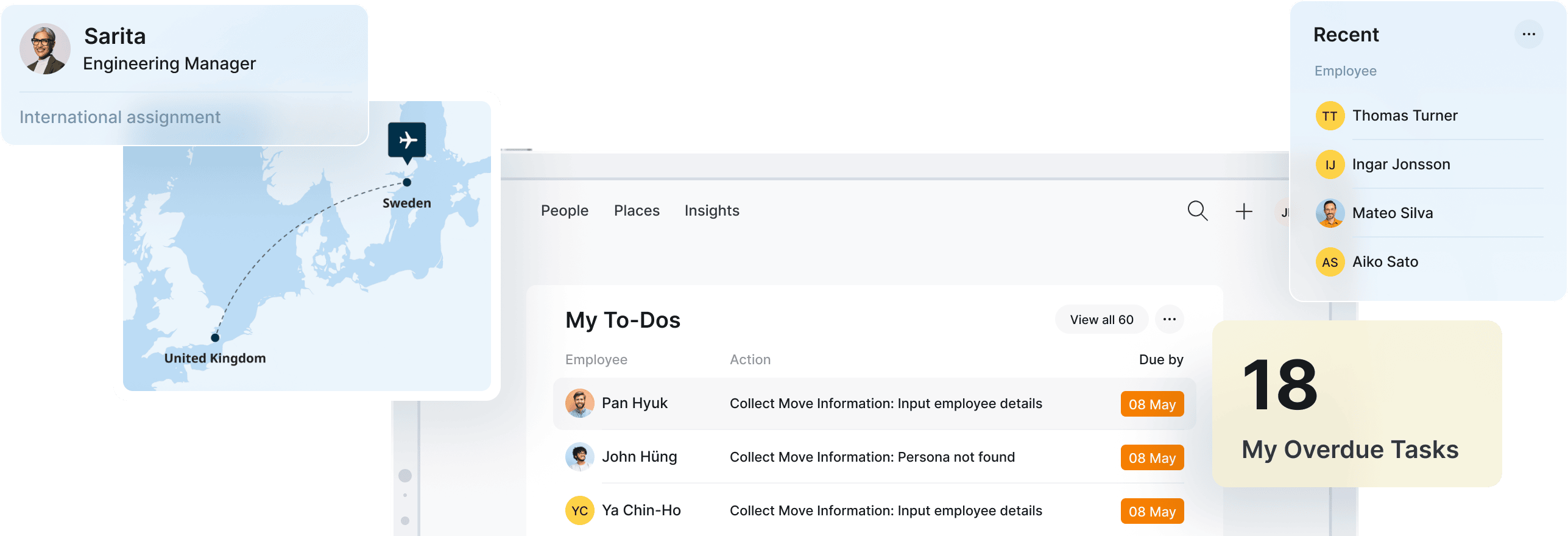
The module opens with an interactive world map that gives mobility teams real-time visibility into where remote workers are located, where open requests are pending, and how risk is distributed across global locations.
The map supports zoom and pan, and allows teams to initiate new remote work requests directly from a geographic location, a meaningful UX decision that anchors compliance conversations in the actual geography they're about to affect. Risk levels are visualized directly on the map, so a team managing thirty simultaneous remote work requests across fifteen countries can see at a glance where exposure is concentrated.
This kind of program-level visibility simply does not exist in spreadsheet-based workflows.
Structured Multi-Step Approval Workflows
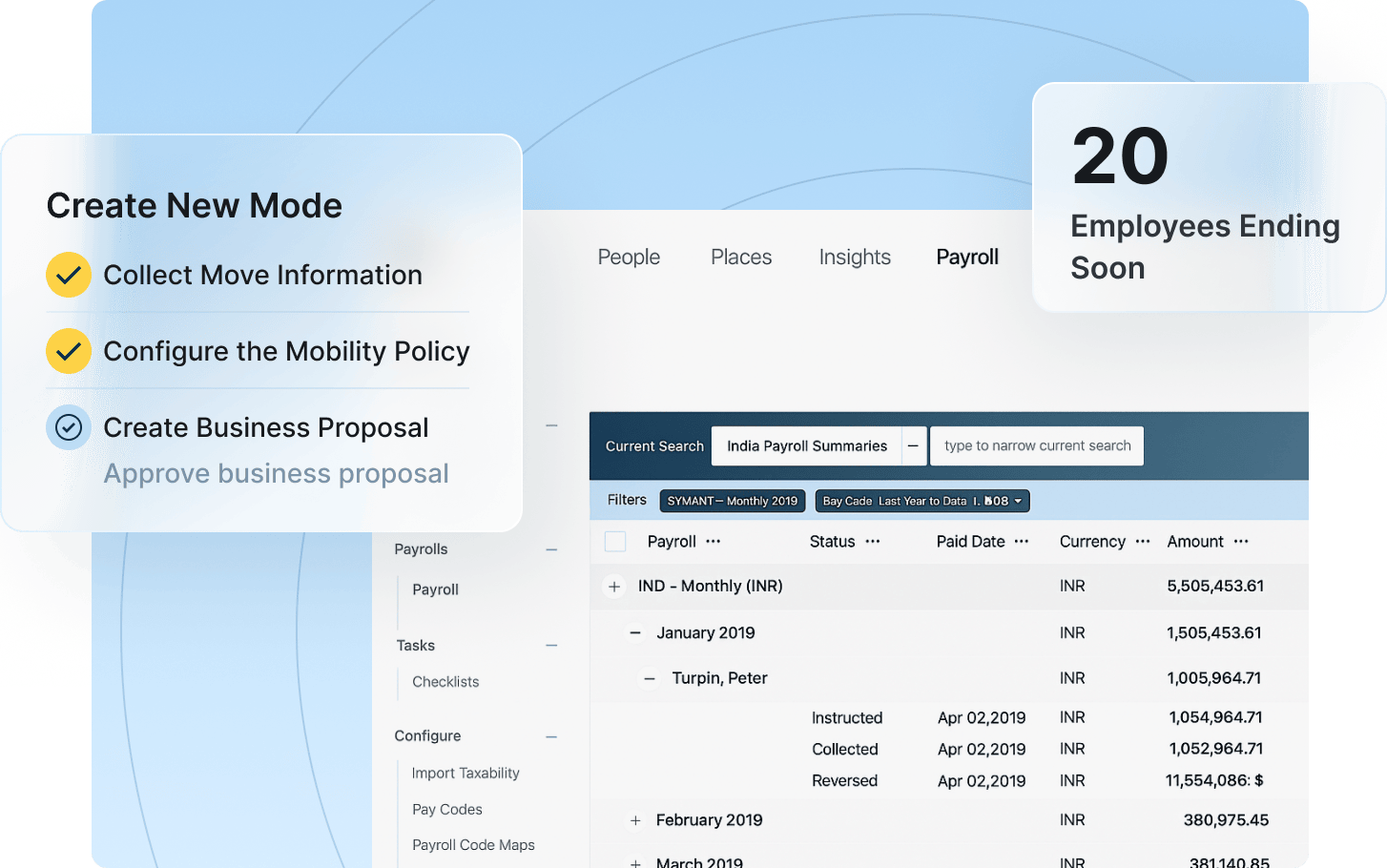
Every remote work request in Horizon moves through a defined approval chain: manager approval, then HR review, then compliance sign-off. Each step is logged, timestamped, and tied to the specific request record.
This structure matters for several reasons. It ensures that the people with the right context are reviewing requests at the right stage: a manager understands business necessity, HR understands employment policy, and compliance understands legal exposure. It also creates a defensible paper trail if a regulatory question arises later.
Organizations can configure workflows to match their internal governance structures. Duration types, temporary, permanent, or project-based, are specified at the point of request creation, which drives downstream risk assessment logic appropriately.
Automated Risk Assessments Across Four Compliance Dimensions
The core of Horizon's Remote Work module is its automated risk assessment engine. When a remote work request is submitted, the system evaluates the proposed arrangement across four categories:
- Tax risk. Based on origin country, destination country, employment type, and duration, the engine surfaces applicable tax obligations and flags arrangements that are likely to create withholding complexity or trigger treaty considerations.
- Immigration risk. The system evaluates whether the employee's current immigration status permits work activity in the destination country, and flags arrangements where authorization is ambiguous or clearly absent.
- Social security risk. Horizon assesses whether the proposed remote work arrangement disrupts applicable social security agreements and whether dual contribution exposure exists.
- Permanent establishment risk. For arrangements where the employee's role or activities could constitute a taxable presence in the destination country, the engine surfaces this risk proactively, before the arrangement begins, not after.
Each of these assessments produces a risk level indicator (Low, Medium, or High) that feeds into the approval workflow. High-risk arrangements surface directly to compliance reviewers with the supporting rationale, so reviewers are making informed decisions rather than rubber-stamping requests they don't have the context to evaluate.
This is the difference between a compliance function that catches risks before they materialize and one that writes remediation memos after the fact.
Why "Before It Happens" Is the Only Acceptable Standard
A common pattern in organizations that manage cross-border remote work manually is what compliance professionals call the "pleasant surprise problem." An employee asks their manager if they can work from Spain for the summer. The manager says yes, because they don't know the answer is more complicated than that. HR finds out three months later. Tax finds out at year-end. By the time the organization understands what obligations were created, it's too late to structure the arrangement in a way that manages them.
Horizon's architecture is built around a different premise: risk assessment happens before approval, not after discovery.
Every compliance evaluation, tax, immigration, social security, permanent establishment, is generated when a request is submitted, before any approver acts on it. This means the manager approving the request sees the risk profile. HR reviewing the request sees the tax and immigration flags. Compliance signing off has full context for every dimension of exposure.
This is not just a workflow improvement. It's a fundamentally different relationship between operational decisions and compliance outcomes.
Collaboration and Audit Built Into Every Request
Horizon's Remote Work module includes the same collaboration infrastructure as the rest of the platform: conversation notes with @mention support, automated notifications on status changes, and a full audit trail on every record.
This matters in practice because remote work decisions are rarely made by one person. A manager approves the business case, HR reviews the employment implications, a tax advisor weighs in on the PE question, and legal may need to be looped in on immigration. In a traditional workflow, this coordination happens over email, with context scattered across threads and no single record of what was decided and why.
In Horizon, every note, every status change, every approval, and every risk assessment override is logged against the request record with author attribution and timestamps. @mentions trigger real-time notifications to tagged team members, so the right people are in the loop without anyone having to chase them.
The audit log is not just a compliance nicety. It is a genuine operational tool. When a question arises six months after an arrangement was approved, the answer is in the platform.
Who This Is Built For
Horizon's Remote Work module is relevant to several stakeholders with distinct needs:
- Global mobility teams managing high volumes of cross-border requests need structured workflows and program-level visibility. The interactive map and filterable request queue give them both.
- HR business partners working with line managers on remote work requests need guardrails that surface compliance questions without requiring deep specialist knowledge. Horizon's automated assessments do exactly that, they flag risks in plain language at the point of decision.
- Tax and legal teams responsible for PE risk, withholding obligations, and immigration compliance need a system that catches high-risk arrangements before they are approved, and that creates a documented record of every decision. Horizon's risk assessment engine and audit trail address both needs.
- Finance leaders who need to understand the cost and liability implications of a distributed workforce benefit from Horizon's integration with the broader platform, remote work data lives alongside simulation data, policy data, and analytics in a single environment.
Horizon's Remote Work Module in the Context of the Broader Platform
Remote Work is one of three core pillars in Horizon by Topia, alongside Relocation Cost Modeling and Pre-Travel Risk Assessment. The integration across these modules is not incidental. It reflects how global mobility actually works.
An employee who is being relocated from the US to Germany may also need to travel to the UK for a client engagement before their assignment starts and may want to work remotely from Portugal for two weeks during the transition. In a fragmented toolset, each of these scenarios is managed in a different system with no shared context. In Horizon, all three are visible from a single platform, linked to the same employee record, and governed by the same policy framework.
This is the structural advantage Horizon has over point solutions: context is preserved across every dimension of mobility, and the compliance team has a complete picture of every employee's risk profile at any given time.
Getting Started with Remote Work in Horizon
If you're currently managing cross-border remote work requests through email, shared documents, or disconnected tools, the path to Horizon is straightforward. The platform is designed for global mobility teams that are ready to move from reactive compliance to proactive governance, without requiring a multi-year implementation project to get there.
The Remote Work module is accessible from the main navigation in Horizon. You can create a remote work request directly from the interactive map, link it to an employee in the directory, specify the duration type and dates, and trigger the automated risk assessment in a single workflow.
For organizations that want to explore the platform's broader capabilities, including cost simulation and pre-travel compliance, Topia's team is available for personalized demos.
Frequently Asked Questions
- What is cross-border remote work compliance?
- Cross-border remote work compliance refers to the legal, tax, and immigration obligations that arise when an employee works remotely from a country other than where they are employed. These obligations can include payroll tax withholding, social security contributions, immigration authorization, and permanent establishment exposure for the employer. Managing these proactively, before an arrangement begins, is considered best practice.
- What is permanent establishment risk in remote work?
- Permanent establishment (PE) risk arises when an employee working in a foreign country is deemed to create a taxable presence for their employer in that country. This can happen when an employee habitually concludes contracts on behalf of the employer, or maintains a fixed place of business there. PE exposure can result in the employer being subject to corporate income tax in the foreign jurisdiction, which is why early-stage risk assessment is critical.
- How does Horizon assess remote work risk?
- Horizon evaluates remote work requests across four dimensions: tax withholding obligations, immigration status, social security implications, and permanent establishment risk. Each assessment is automated based on the origin country, destination country, employment type, and duration of the proposed arrangement. Results are surfaced as Low, Medium, or High risk indicators, and high-risk requests are escalated automatically within the approval workflow.
- What is a multi-step approval workflow for remote work?
- A multi-step approval workflow routes a remote work request through a defined sequence of approvers, typically manager, HR, and compliance, before it is authorized. Each step is logged with timestamps and approver identity. Horizon supports configurable approval chains with automated notifications at each stage.
- Can Horizon handle temporary, permanent, and project-based remote work?
- Yes. Horizon's Remote Work module supports three duration types: temporary (time-limited arrangements), permanent (indefinite remote work from a foreign location), and project-based (tied to a specific deliverable or engagement). The duration type is captured at request creation and influences the downstream risk assessment.
- How does Horizon differ from managing remote work in a spreadsheet?
- Spreadsheet-based remote work management typically lacks automated risk assessment, structured approval workflows, real-time compliance visibility, and a complete audit trail. Horizon replaces all of these manual processes with a purpose-built system that surfaces compliance risks before approvals are granted, maintains a full record of every decision, and gives mobility teams program-level visibility through an interactive map and filterable request queue.
- Does Horizon integrate with other HR systems?
- Horizon's Remote Work module is part of the broader Horizon by Topia platform, which includes an Employee Directory, Simulations, Pre-Travel Assessments, and Policy Management. Employee data can be loaded into the platform and linked across all modules. For information about specific integrations with HRIS or payroll systems, contact Topia directly.
- What compliance risks does cross-border remote work create for employers?
- Employers face several categories of compliance exposure when employees work cross-border: corporate tax liability through permanent establishment, payroll tax withholding obligations, social security contribution requirements, and immigration violations if the employee is not authorized to work in the destination country. The severity varies by country pair, duration, and the nature of the employee's work activities.
- How does Horizon's risk assessment engine work?
- Horizon's risk assessments are powered by Topia's proprietary tax and immigration engine, which incorporates country-specific rules, treaty data, and compliance thresholds. When a remote work request is submitted, the engine evaluates the specific parameters of the arrangement against this ruleset and generates a risk profile across all four compliance dimensions. The output is surfaced to approvers in plain language, with a Low / Medium / High risk designation for each category.
- Where can I learn more about Horizon by Topia?
- You can learn more about Horizon's full feature set, including Remote Work, Cost Simulations, Pre-Travel Assessments, and the AI-Assisted Policy Agent, at topia.com/horizon. To see the platform in action, you can request a personalized demo with a member of the Topia team.